195+ Principles to Validate Any Design
195 principles organized by topic and difficulty. Each one includes citations, product examples, and AI prompts ready to paste into Cursor, V0, or Claude.
Good design is not based on instinct. It is based on how people actually process information: what they notice, what they ignore, and why they leave.
These 195 principles cover the patterns behind those decisions. Browse by part, filter by difficulty, or search for a specific problem. Each one links to the research and includes AI prompts you can paste straight into your tool of choice.
Showing 1–12 of 61 principles

Free
Conversational Flow Principle
Poor conversational design increases clarification requests 3-5x. Apply Grice's maxims to build chatbots and voice UIs that users actually understand.
Fixes:Form GraveyardMystery Nav
Explore principle
Free
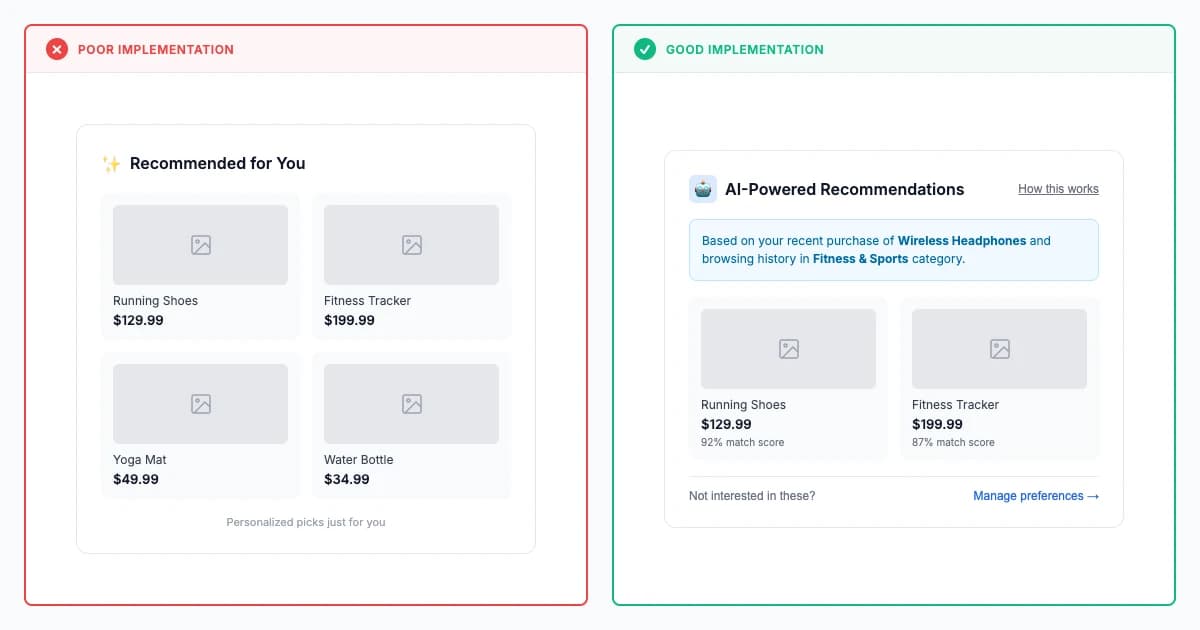
AI Transparency Principle
AI transparency (DARPA XAI 2017, Jobin et al. 2019) requires explainable reasoning and disclosed limitations, with transparent systems improving decision accuracy 40-60% and reducing bias 30-40% through verified reasoning and appropriate trust calibration.
Fixes:Silent ErrorsMystery Nav
Explore principle
Premium
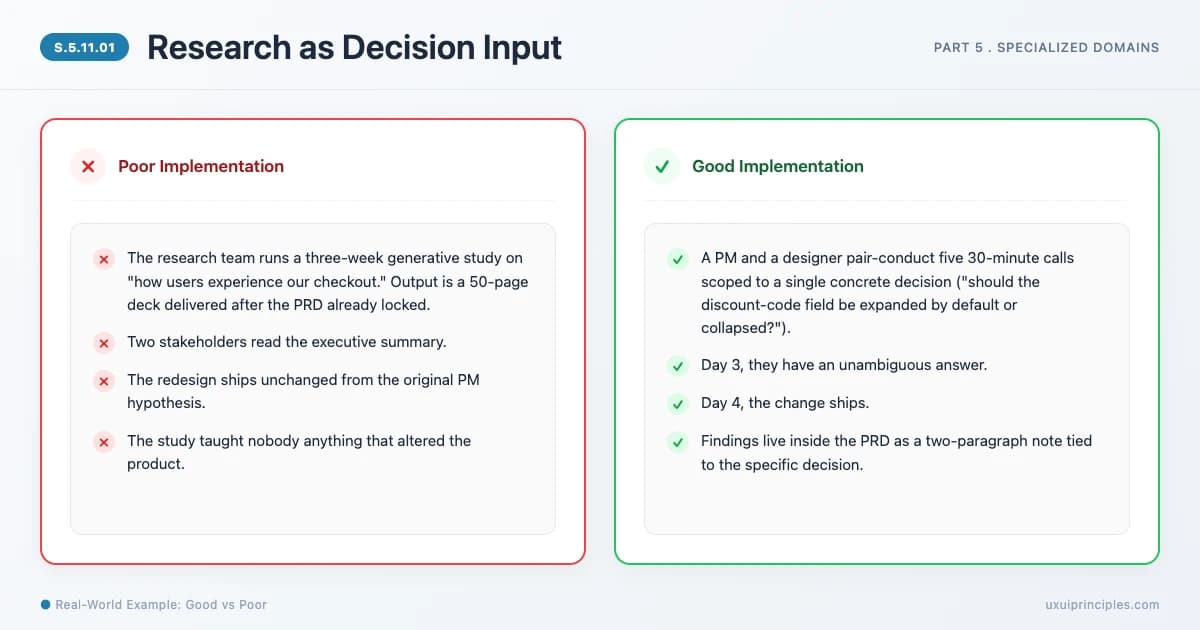
Research as Decision Input
Research as Decision Input reframes UX research around the specific decisions it must inform, not around polished report deliverables. Research scoped to decisions ships 3-5x faster than report-driven research and lands measurably more impact on shipped product (Hall, 2019; Torres, 2021). The principle holds across enterprise teams, small startups, and solo founders running their own research.
Explore principle
Get Full Access
195 research-backed principles
$59/year
- All principles with citations
- AI prompts for every principle
- Real-world examples
14-day money-back guarantee
Premium
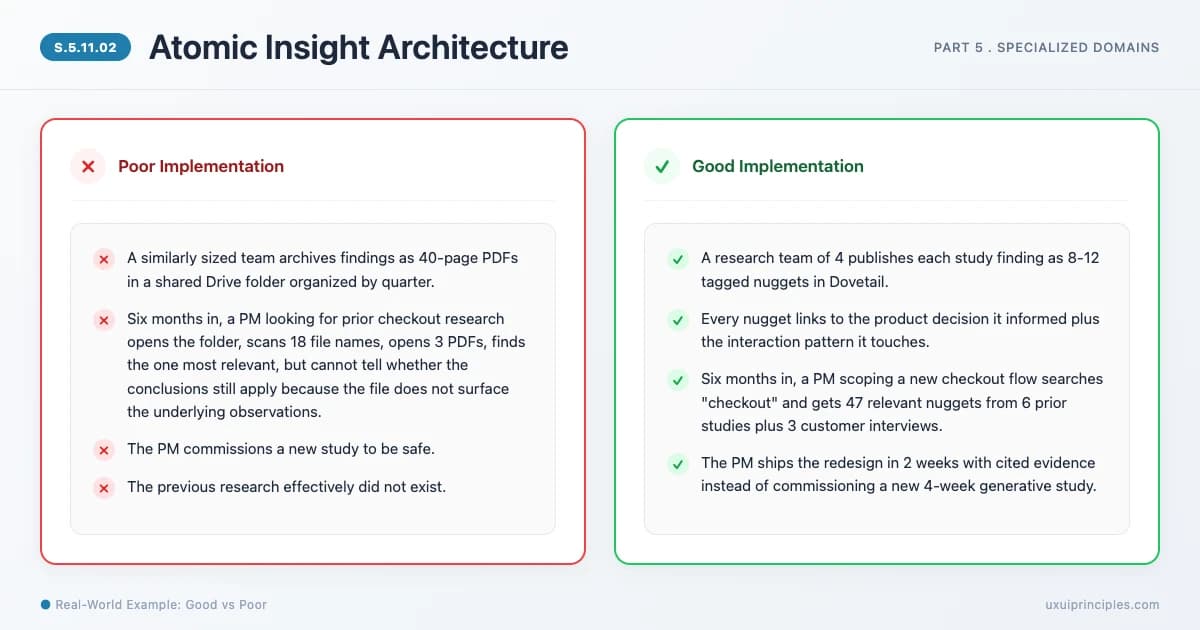
Atomic Insight Architecture
Atomic Insight Architecture breaks research output into tagged, searchable insight units instead of monolithic reports. Teams that adopt the pattern report 3-5x higher insight reuse across product decisions and a measurable drop in repeat studies (Pidcock, 2019; Dovetail, 2022). The shift is structural: the unit of knowledge becomes the indexed insight, not the delivered deck.
Explore principle
Premium
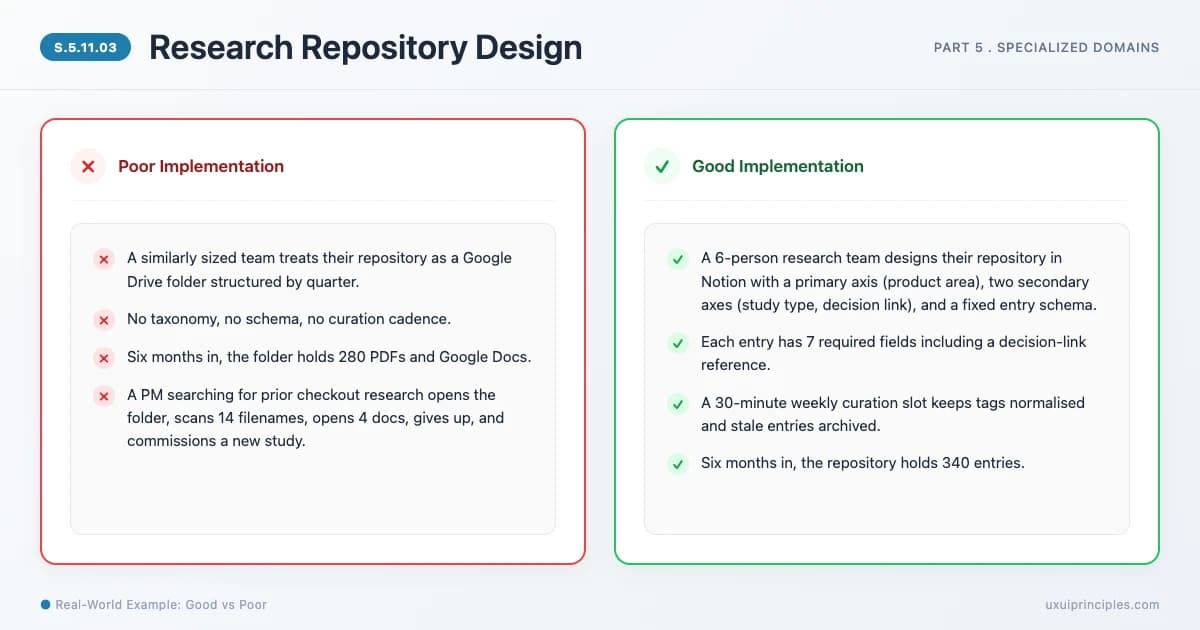
Research Repository Design
Research Repository Design treats the research repository as an information architecture problem first, not a storage problem. The taxonomy, the findability path, and the retrieval cost decide whether the repo compounds organisational knowledge or accumulates noise. Teams that design the repo as IA report 4x faster insight retrieval than teams treating it as a Google Drive folder (Rosenfeld et al., 2015; User Interviews, 2025).
Explore principle
Premium
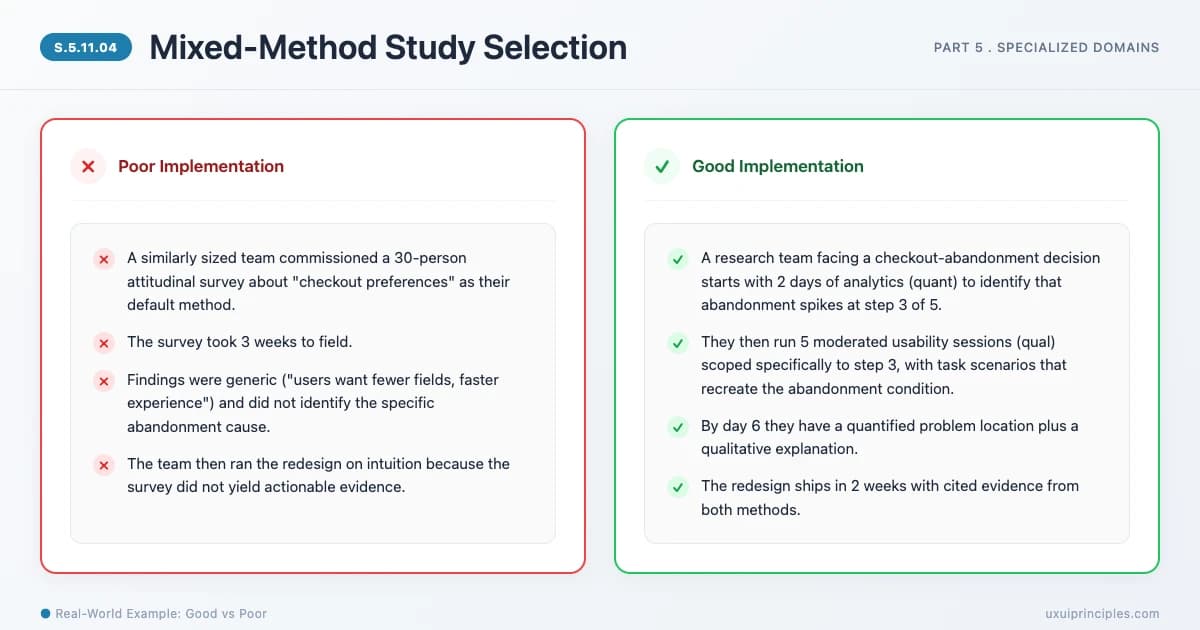
Mixed-Method Study Selection
Mixed-Method Study Selection picks the research method that matches the decision under uncertainty, then combines methods when neither alone would close the gap. Teams that explicitly pair qualitative and quantitative methods report substantially higher decision confidence than teams running single-method studies (Creswell, 2017; Rohrer, 2022). The principle is structural: name the decision risk, pick the method whose strength addresses it, add a second method when the first cannot.
Explore principle
Premium
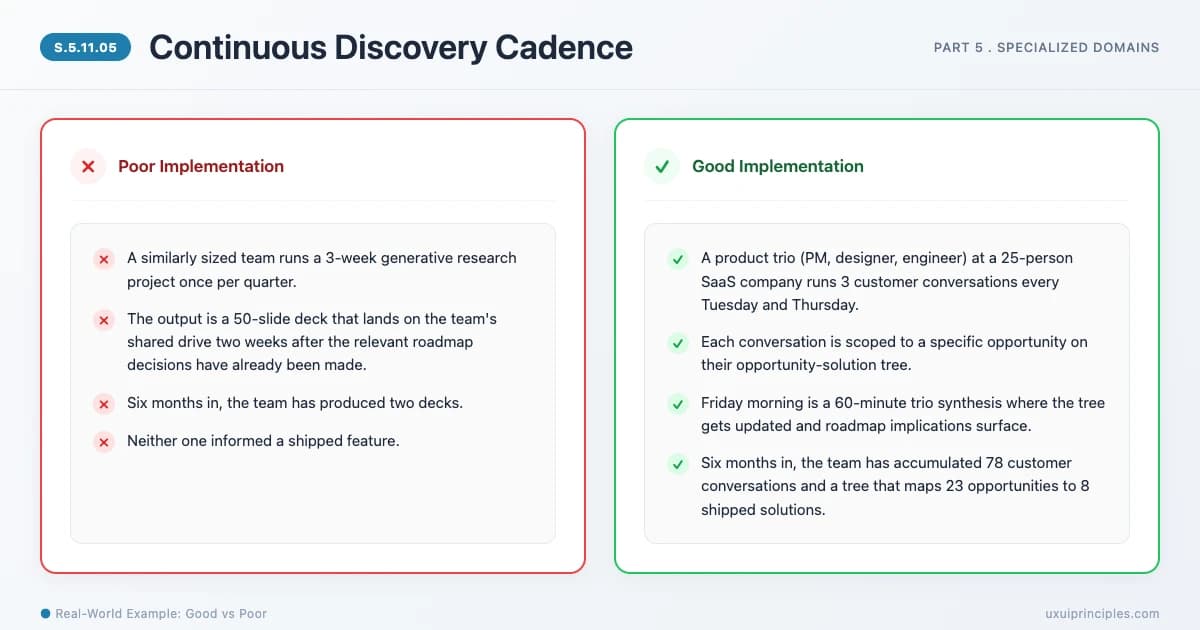
Continuous Discovery Cadence
Continuous Discovery Cadence runs weekly customer touchpoints scoped to specific product decisions the team is making this week. Teams that adopt the cadence report substantially higher feature-to-need match rates and decision cycle times measured in days not weeks (Torres, 2021; ProductPlan, 2025). The principle is structural: weekly touchpoint, scoped to a current decision, run by the trio (PM + designer + engineer).
Explore principle
Premium
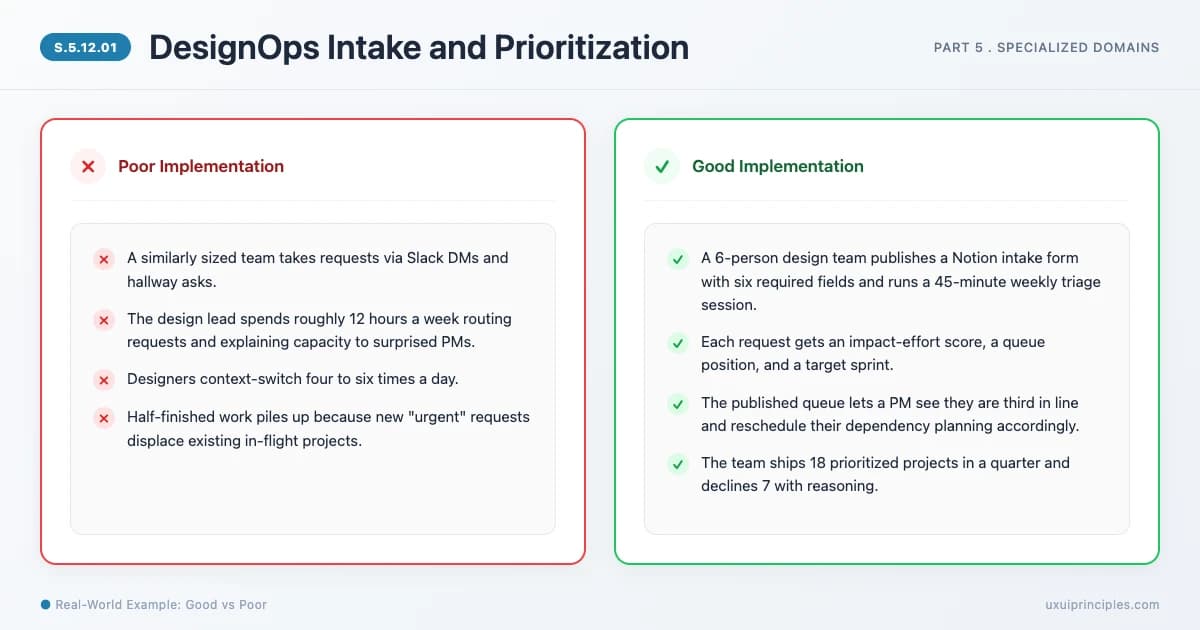
DesignOps Intake and Prioritization
DesignOps Intake and Prioritization replaces ad-hoc Slack requests with a structured form plus impact-effort triage. Teams that adopt structured intake report 40-60% less rework and ship roughly 2x the prioritized work per quarter at flat headcount (Kaplan, 2020; NN/G DesignOps Planning Workbook). The principle is the smallest practical step toward DesignOps maturity in growing teams.
Explore principle
Premium
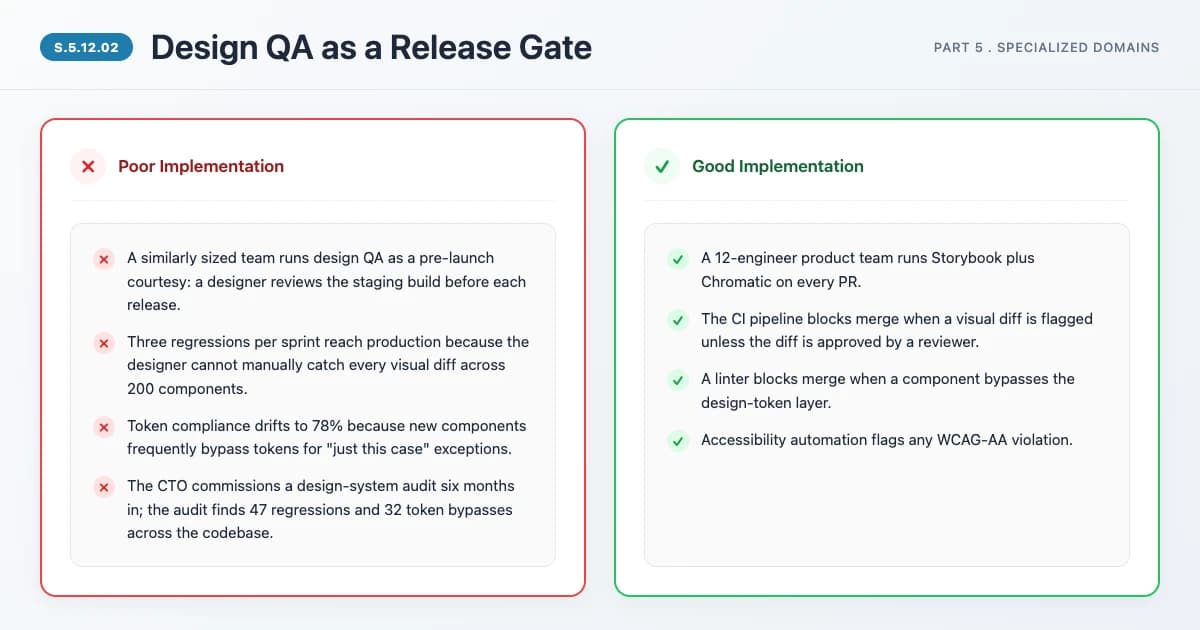
Design QA as a Release Gate
Design QA as a Release Gate treats design quality checks as hard release blockers rather than pre-launch courtesies. Teams that adopt the gate report 60-80% fewer post-release design regressions and measurably cleaner design-system token compliance (Curtis, 2023; Storybook Visual Testing Handbook). The principle is structural: define the gate, automate the checks, block the merge when checks fail.
Explore principle
Premium
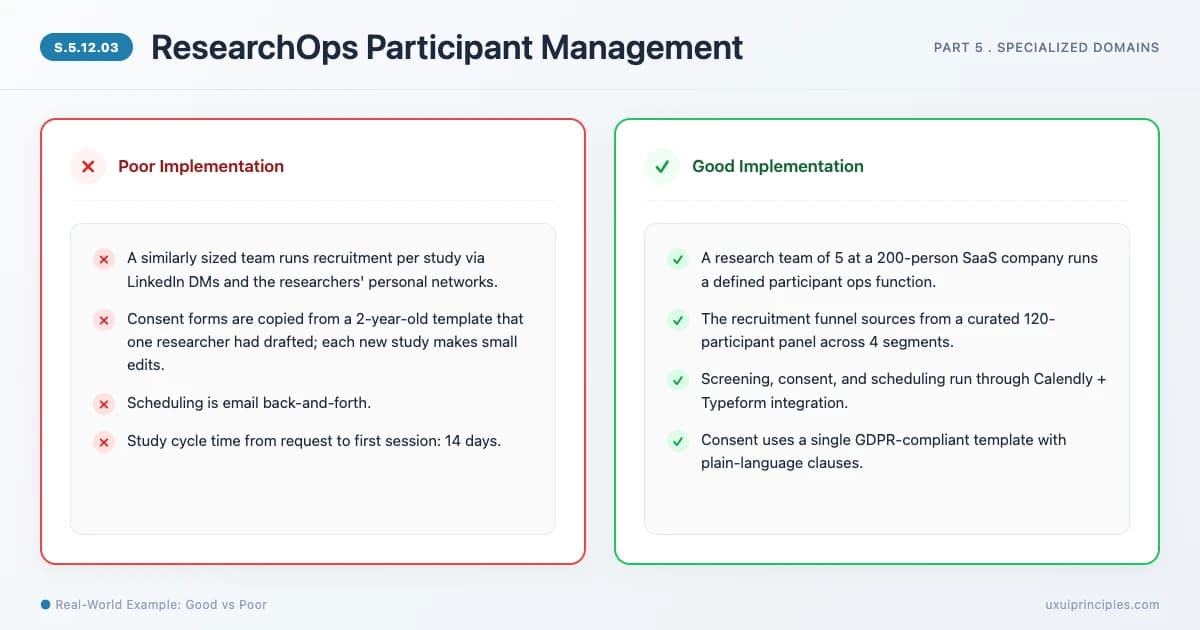
ResearchOps Participant Management
ResearchOps Participant Management runs recruitment, consent, scheduling, and incentives as an operations function rather than as the researcher's side-project. Teams with a defined participant operations function report substantially faster study turnaround, cleaner GDPR compliance, and measurably healthier participant panels than teams running ad-hoc recruitment (User Interviews, 2025; ReOps Community).
Explore principle
Premium
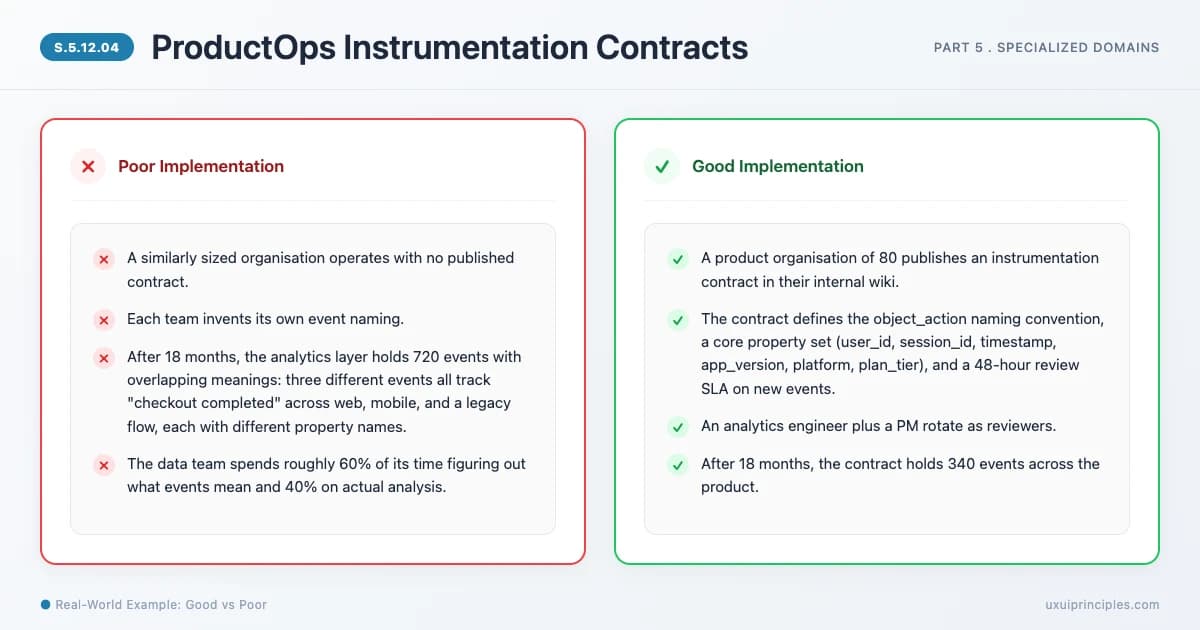
ProductOps Instrumentation Contracts
ProductOps Instrumentation Contracts publishes the analytics event taxonomy as a written contract between product, engineering, and analytics teams. The contract names every event, names every property, and gates new events through a review. Teams that adopt the contract pattern report substantially cleaner analytics data and faster cross-team interpretation than teams running ad-hoc event naming (Segment, 2024; Amplitude, 2024).
Explore principle
Premium
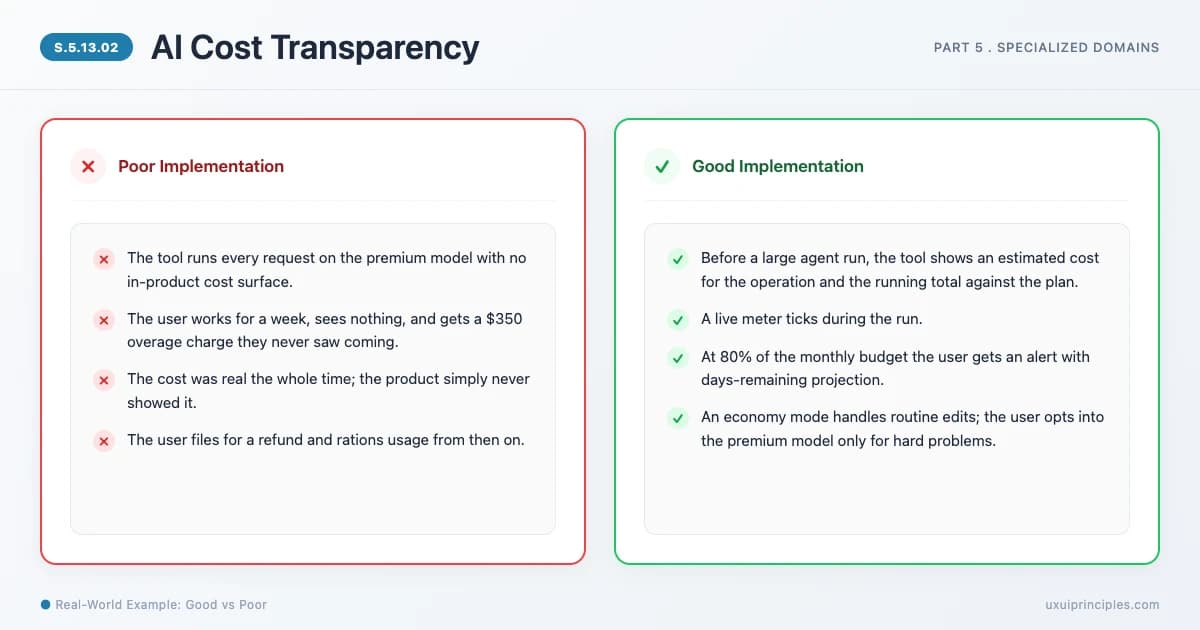
AI Cost Transparency
AI Cost Transparency means surfacing AI cost at the moment of decision, in units users understand, with predictable-burn controls. The 2025-2026 shift to usage-based AI pricing produced meter shock when cost UX lagged (GitHub, 2026). Grounded in feedback and prospect theory (Norman, 2013; Kahneman and Tversky, 1979), the principle holds across dev tools, SaaS, fintech, and enterprise FinOps for AI.
Explore principle