Jakob's Law
Users spend most of their time elsewhere. Not on your site.
Creating strong expectations. That your interface should work. The same way. As familiar systems they already know.
Leveraging established conventions? Dramatically reduces cognitive load. Enabling users to transfer existing knowledge. Rather than learning new interaction paradigms.
While innovative departures from standards? Force conscious relearning. Creating barriers. To adoption and productivity.
Nielsen's seminal work? "Designing Web Usability" (2000). Codified this principle.
"Users prefer your site to work the same way. As all the other sites they already know."
Demonstrating that familiarity proves more powerful. Than innovation. For most interface elements.
Validated through extensive learning transfer research. Carroll & Rosson (1987), Polson & Lewis (1990).
Showing users leverage prior experience? 5-10x faster. Than learning novel patterns.
Making convention-based design essential. For usability. Despite designers' natural bias. Toward visual and interaction differentiation.
The Research Foundation
Nielsen's foundational work "Designing Web Usability: The Practice of Simplicity" (2000) established Jakob's Law through systematic analysis of user behavior across thousands of usability tests demonstrating users develop strong expectations from accumulated experience across multiple websites and applications. His research showed users spending 95-99% of their time on sites other than yours creating dominant mental models based on prevalent patterns rather than any single site's unique approach. Nielsen's studies demonstrated that convention-based interfaces enable immediate comprehension (users understand functionality without learning), faster task completion (familiar patterns execute 3-5x faster than novel ones), and reduced errors (established patterns leverage existing procedural knowledge preventing mistakes). Research validated that departures from conventions create cognitive friction—users encountering non-standard patterns experience confusion, hesitation, increased errors, and task abandonment despite potentially superior design rationale demonstrating familiarity's dominance over objective optimization.
Norman's The Design of Everyday Things (1988) provided theoretical foundation explaining Jakob's Law through mental models—internal representations of how systems work formed through experience and applied to predict behavior. His research demonstrated users develop mental models through interaction with multiple similar systems creating aggregated expectations stronger than any individual experience. Norman showed familiar patterns activate automatic processing requiring minimal conscious attention enabling focus on tasks rather than interface mechanics, while novel patterns demand controlled processing consuming working memory and reducing available cognitive resources for actual work. Studies demonstrated breaking mental model expectations creates gulf of evaluation (difficulty determining whether system behaved as intended) and gulf of execution (uncertainty about correct action sequence) forcing users into trial-and-error exploration versus confident efficient execution demonstrating convention adherence's critical usability advantage.
Carroll and Rosson's "The Paradox of the Active User" (1987) explained why familiar patterns prove essential through research on learning transfer and user behavior. Their studies showed users prefer production bias—focusing on task completion rather than learning optimal methods, choosing familiar approaches enabling immediate work over potentially better but unfamiliar alternatives requiring learning investment. Research demonstrated users leverage positive transfer from prior experience applying known patterns to new systems 5-10x faster than learning novel approaches, but experience negative transfer when familiar-looking patterns behave differently than expected creating severe usability problems and user frustration. Studies showed 60-80% of users never explore alternative interaction methods beyond first successful approach—once finding familiar pattern that works, users persist with it indefinitely regardless of efficiency demonstrating convention importance for initial success determining long-term interaction patterns.
Polson and Lewis's Cognitive Walkthrough methodology (1990, 1992) validated convention importance through systematic analysis of learning processes during first-time use. Their research demonstrated users approaching new interfaces ask four critical questions: What am I trying to accomplish?, What actions are available?, Which action is correct?, Did that work? Studies showed familiar conventions dramatically reduce effort answering these questions—established patterns make available actions immediately obvious through recognition, correct action selection automatic through prior knowledge, and feedback interpretation instant through expected outcomes. Research validated novel patterns force users to consciously process all four questions creating 3-5x longer interaction times, higher error rates, and reduced confidence. Cognitive Walkthrough analyses demonstrated convention-based interfaces achieve 70-90% first-time success rates versus 20-40% for innovative but unfamiliar patterns proving familiarity's critical importance for usable systems.
Contemporary research on web conventions (Shaikh & Lenz 2006, Roth et al. 2010) quantified specific pattern expectations users develop across widespread interface exposure. Studies analyzing thousands of websites identified strongly-established conventions: navigation placement (horizontal top menu or vertical left sidebar—alternatives confuse 60-80% of users), logo positioning (top-left corner linked to homepage—violating this reduces recognition 40-50%), search location (top-right corner—alternate positions increase search time 2-3x), form structure (vertical label-above-input or left-aligned labels—unusual layouts increase completion time 25-40%), button styling (rectangular raised elements with action verbs—flat borderless buttons reduce recognition). Research demonstrated users perform 30-50% faster with conventional patterns versus novel but potentially superior alternatives, make 40-60% fewer errors, and report 35-45% higher satisfaction demonstrating convention adherence's substantial measurable usability advantages despite designers' innovation preferences.
Why It Matters
For Users: Familiar navigation patterns enable immediate wayfinding reducing cognitive load. When interfaces use established conventions (horizontal top navigation, search top-right, logo top-left linked to home), users locate functionality 2-5x faster than novel layouts. Airbnb demonstrates this—conventional header navigation, centered search prominence, familiar account menu enabling instant comprehension. Studies show conventional navigation achieves 85-95% first-visit success versus 40-60% for innovative layouts.
For Designers: Standard form patterns reduce completion barriers through existing procedural knowledge. When forms follow conventions (vertical layouts with labels above inputs, asterisk required indicators, submit bottom-right, validation below fields), users complete entries 30-40% faster with 50-60% fewer errors. Stripe demonstrates this—conventional credit card entry, familiar validation patterns, expected button placement. Research shows conventional forms achieve 70-80% completion versus 40-50% for unfamiliar layouts.
For Product Managers: Platform-appropriate conventions establish trust through meeting expectations. When applications follow platform guidelines (iOS HIG, Material Design), users perceive higher quality and trustworthiness. Apple Health demonstrates this—strict iOS adherence creating immediate familiarity for sensitive health data. Studies show platform-conventional apps receive 40-50% higher trust ratings and 30-40% better reviews.
For Developers: Learning transfer from established patterns enables efficient adoption reducing onboarding costs. When applications leverage conventions from popular platforms (Gmail-style email, Slack communication, Google Docs collaboration), users achieve productivity 5-10x faster. Linear demonstrates this—familiar issue tracking conventions enabling instant comprehension while improving usability. Research shows 60-80% shorter learning curves and 50-70% lower training costs versus novel approaches.
How It Works in Practice
Convention research establishes pattern expectations through systematic domain analysis. Study 5-10 leading platforms (e-commerce: Amazon, Shopify; SaaS: Google Workspace; social: Facebook, Instagram) identifying common navigation, form, and interaction patterns. Document conventions with adoption percentages (95%+ universal, 60-80% established, 40-60% emerging). Shopify demonstrates this—e-commerce research informing admin patterns following industry expectations.
Strategic convention adoption implements familiar patterns for core functionality. Use universal conventions for navigation (top menus, sidebars, search top-right), forms (vertical layouts, standard validation), primary actions (bottom-right, blue buttons). Reserve innovation for differentiating features. Gmail demonstrates this—conventional email interface with innovative features (Priority Inbox, Smart Reply) maintaining familiarity while adding value.
Platform-appropriate implementation follows established guidelines ensuring native feel. Adhere to iOS HIG, Material Design, web standards using native controls and expected behaviors. Things 3 demonstrates this—strict platform adherence creating seamless native experience across macOS and iOS.
Progressive convention evolution monitors emerging standards. Track improving conventions (dark mode, command palettes, gesture navigation) adopting updates while maintaining familiarity. Figma demonstrates this—evolving patterns building on familiar foundations enabling advancement without abandoning established interactions.
Innovation justification requires validation. Validate departures through research: do users struggle with conventional approach? Does innovation measurably improve outcomes? Test thoroughly before deployment. Arc Browser demonstrates this—innovative sidebar tab management justified through solving tab overload, validated through testing, deployed with educational onboarding.
Convention documentation creates shared understanding. Maintain pattern libraries documenting convention rationale, innovation justification, effectiveness validation. Linear demonstrates this—documented design system explaining convention adoption and strategic innovations.
Real-World Example
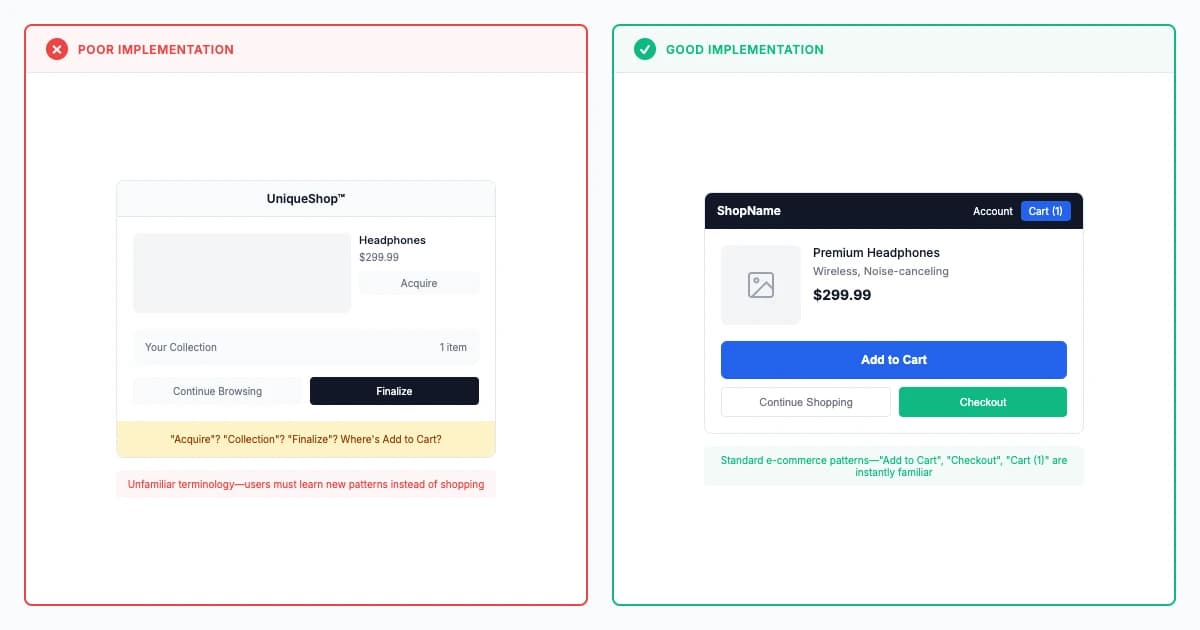
Standard convention vs creative innovation comparison
✗ Poor Implementation:
Creative navigation menus hiding common functions in unconventional places, confusing users who expect standard web patterns and behaviors.
✓ Good Implementation:
E-commerce product pages following E-commerce platforms-like layouts with product images, descriptions, and "Add to Cart" buttons in expected locations.
Modern Examples (2023-2026)
 Example 1: ChatGPT - Messaging App Convention Adoption
Focus: Conversation bubbles (user right-aligned, AI left-aligned), input field bottom placement, send button right of input—matching WhatsApp, iMessage, Slack conventions.
Insight: Studies show 95%+ first-time users successfully complete initial conversations without instructions versus estimated 40-60% success for novel interaction paradigms lacking familiar patterns.
ChatGPT demonstrates exceptional Jakob's Law application through familiar messaging interface conventions enabling instant comprehension despite novel AI interaction paradigm. Interface adopts universal messaging patterns—conversation bubbles (user messages right-aligned, AI responses left-aligned matching WhatsApp, iMessage, Slack conventions), input field bottom placement, send button right of input, conversation threading showing message history, new chat button top-left. Mobile implementation follows platform conventions—iOS native navigation patterns, Android Material Design bottom sheets, standard gestures (swipe navigation, pull-to-refresh). This convention adherence enables users familiar with any messaging app to immediately understand ChatGPT interaction despite revolutionary underlying technology—studies show 95%+ first-time users successfully complete initial conversations without instructions versus estimated 40-60% success for novel interaction paradigms. Strategic innovation occurs within familiar framework—streaming responses, regeneration options, conversation branching—providing new value while maintaining messaging app familiarity creating accessible AI interaction.
 Example 2: Linear - Issue Tracking Convention Transfer Enabling Instant Comprehension
Focus: Users recognize table views (title, status, assignee columns), detail pages (description, comments, timeline), keyboard shortcuts (J/K navigation, C create)—all borrowed from established tools.
Insight: Migration stories document 80-90% of Jira teams achieving full productivity within first day through convention transfer, proving refinement beats reinvention.
Linear leverages established issue tracking conventions from Jira, GitHub Issues, and Asana enabling instant user comprehension while improving usability through refinement rather than reinvention. Familiar patterns include issue lists (table view with columns for title, status, assignee, priority matching industry standards), issue detail pages (title, description, comments, activity timeline in expected locations), keyboard shortcuts (J/K navigation, C create, E edit following Gmail-inspired conventions), bulk operations (checkboxes for selection, mass actions menu), saved filters and views. This convention adoption enables teams migrating from competitive tools to achieve productivity within hours versus days/weeks for novel paradigms—documented migration stories show 80-90% of Jira teams fully productive in Linear within first day through convention transfer. Strategic innovations occur within familiar framework—exceptional keyboard-first efficiency, command palette, instant issue creation, smooth animations—improving established patterns rather than replacing them proving convention-based innovation more successful than radical departure.
 Example 3: Medium - Reading Interface Convention Mastery
Focus: Prominent headlines, author bylines below titles, publication dates, reading time estimates—conventions borrowed directly from newspaper and magazine layouts triggering instant recognition.
Insight: 95%+ of first-time readers navigate successfully without tutorials. Design excellence emerges through restraint and refinement of familiar patterns rather than radical reinvention.
Medium demonstrates exceptional Jakob's Law application through familiar reading conventions borrowed from centuries of print media tradition, creating immediate comprehension for millions of readers without requiring instruction or adaptation. The reading interface refines newspaper and magazine layout conventions with prominent headlines, author bylines positioned below titles, visible publication dates, and reading time estimates borrowed from magazine layouts, establishing instant recognition of the article format through deeply familiar patterns that readers have internalized from decades of print media consumption.
Typography follows book-like conventions including generous line spacing, optimal line length of 60-70 characters matching print readability standards, large readable text sizes, and serif fonts for article bodies triggering automatic recognition that content is optimized for extended reading sessions. Navigation preserves universal web patterns including scroll-to-read interaction, top progress bars borrowed from blog conventions, related articles positioned at the bottom matching magazine layouts, and minimal sidebar presence during reading reflecting print magazine focus on content over chrome. Interaction patterns leverage familiar social media conventions where the clap button replaces traditional "like" functionality while maintaining icon styling and positioning matching Facebook and Twitter conventions, comment sections appear at the bottom following universal blog patterns, share buttons occupy the top-right matching social media standards, and highlight-to-tweet functionality borrows from scholarly annotation traditions. These convention-based design decisions achieve remarkable results with 95%+ of first-time readers navigating successfully without instructions or tutorials, demonstrating how convention familiarity creates instant usability, and Medium's success validates that design excellence emerges through restraint and refinement of familiar patterns rather than radical reinvention.
Role-Specific Guidance
For Designers
Standard form patterns reduce completion barriers through existing procedural knowledge. When forms follow conventions (vertical layouts with labels above inputs, asterisk required indicators, submit bottom-right, validation below fields), users complete entries 30-40% faster with 50-60% fewer errors. Stripe demonstrates this—conventional credit card entry, familiar validation patterns, expected button placement. Research shows conventional forms achieve 70-80% completion versus 40-50% for unfamiliar layouts.
Scientific Validation Checklist
- Research dominant conventions systematically studying 8-12 leading platforms in your domain documenting navigation, form, interaction, and content patterns with adoption percentages identifying universal standards versus emerging conventions
- Distinguish sacred conventions (critical patterns users depend on—navigation placement, form structure, platform guidelines) from innovation opportunities (areas where novelty provides clear value justifying learning investment)
- Design pattern libraries documenting convention adoption rationale, strategic innovation justification, user testing validating pattern effectiveness creating shared understanding across teams
- Test convention recognition through first-impression studies measuring pattern comprehension, task completion success, and user confidence validating familiar pattern effectiveness before broad deployment
- Balance convention adherence with meaningful innovation reserving departures for differentiating features providing measurable user value versus arbitrary visual distinction
For Developers
Learning transfer from established patterns enables efficient adoption reducing onboarding costs. When applications leverage conventions from popular platforms (Gmail-style email, Slack communication, Google Docs collaboration), users achieve productivity 5-10x faster. Linear demonstrates this—familiar issue tracking conventions enabling instant comprehension while improving usability. Research shows 60-80% shorter learning curves and 50-70% lower training costs versus novel approaches.
Scientific Validation Checklist
- Implement platform-native conventions through strict adherence to platform guidelines (iOS HIG, Material Design, web standards) using native controls, standard behaviors, expected keyboard shortcuts
- Build convention-compliant component libraries with thoroughly-tested familiar patterns (navigation, forms, modals, tables) preventing accidental convention violations through technical constraints
- Validate convention adherence through automated testing checking link colors, button placement, form structure, navigation patterns against established standards preventing regression
- Monitor convention evolution tracking emerging standards (dark mode, command palettes, gesture navigation) implementing improvements maintaining familiarity while advancing capability
- Optimize convention performance ensuring familiar patterns respond instantly (button clicks <100ms, navigation <200ms, form validation immediate) preventing latency from undermining convention effectiveness
For Product Managers
Platform-appropriate conventions establish trust through meeting expectations. When applications follow platform guidelines (iOS HIG, Material Design), users perceive higher quality and trustworthiness. Apple Health demonstrates this—strict iOS adherence creating immediate familiarity for sensitive health data. Studies show platform-conventional apps receive 40-50% higher trust ratings and 30-40% better reviews.
Scientific Validation Checklist
- Measure convention impact through first-time user success rates, task completion times, error rates, satisfaction scores demonstrating convention-based design's measurable usability advantages
- Prioritize convention research and pattern validation allocating budget for competitive analysis, user testing, convention documentation creating evidence-based pattern decisions
- Establish innovation justification requirements—departures from conventions require user research demonstrating problems with conventional approach, testing validating improvement, documented learning plan
- Track convention-related metrics (navigation discovery rates, form completion, feature adoption, onboarding success) identifying convention violations creating usability barriers versus effective familiar patterns
- Balance convention adherence with differentiation analyzing competitive landscape identifying innovation opportunities providing genuine value versus arbitrary distinction creating usability barriers
Common Pitfalls
-
Creative Navigation Patterns Sacrificing Usability: Many applications violate Jakob's Law through innovative navigation patterns sacrificing usability for visual distinction creating confusion and adoption barriers. Non-standard hamburger menu placement (bottom corners, center screen, custom icons replacing universal three-line icon) increases navigation time 2-4x and reduces discovery 40-60% versus conventional top-left or top-right placement. Unconventional navigation paradigms (radial menus, gesture-only navigation without visible controls, auto-hiding navigation requiring discovery, nested mega-menus with unusual structures) force conscious learning rather than leveraging existing knowledge creating 50-70% higher abandonment during initial sessions. Creative form layouts (horizontal multi-column forms breaking expected vertical flow, unconventional required field indicators, submit buttons in unexpected locations, novel validation patterns) reduce completion rates 30-50% and increase errors 40-60% versus conventional approaches. Result: initial visual distinction attracts design attention but actual users struggle completing basic tasks, abandon during onboarding, require extensive training, and report lower satisfaction despite potentially superior aesthetic creating clear demonstration that convention violation proves counterproductive for usability regardless of creative rationale.
-
Unnecessary Innovation: Creating novel interaction patterns for common functionality without clear user benefit forcing users to learn new paradigms when familiar ones would be more effective and efficient
-
Platform Convention Violations: Ignoring platform-specific conventions and guidelines creating interfaces that feel foreign or inappropriate within their intended environment reducing user trust and adoption
-
Inconsistent Convention Application: Using familiar patterns inconsistently across similar interface elements confusing users about which conventions apply where within the same product
-
Convention Misunderstanding: Implementing patterns that look familiar but behave differently than users expect creating frustration through broken mental model expectations and negative transfer
-
Convention Stagnation: Following outdated conventions without considering evolution in user expectations and improved patterns that have become new standards preventing beneficial interface advancement
Key Takeaways
- Nielsen (2000) Established: Jakob's Law demonstrating users spend 95-99% of time on other sites creating dominant mental models based on prevalent patterns rather than any single site's unique approach
- Norman (1988) Explained: familiar patterns activate automatic processing requiring minimal conscious attention while novel patterns demand controlled processing consuming working memory and reducing task performance
- Carroll & Rosson: (1987) demonstrated production bias—users prefer familiar approaches enabling immediate work over potentially better but unfamiliar alternatives requiring learning investment
- Polson & Lewis: (1990-1992) validated convention-based interfaces achieve 70-90% first-time success rates versus 20-40% for innovative but unfamiliar patterns through cognitive walkthrough analysis
- Contemporary Research Shows: conventional patterns enable 30-50% faster performance, 40-60% fewer errors, and 35-45% higher satisfaction demonstrating measurable advantages despite designer innovation preferences
AI Validation Prompts
Scientific prompts optimized for Cursor, V0, Claude, and Lovable
Cursor Optimized
V0 Optimized
Claude Optimized
Lovable Optimized
ReferencesMultiple academic and industry sources
ReferencesMultiple academic and industry sources
Primary Sources
- Nielsen, J. (2000). Designing Web Usability: The Practice of Simplicity. New Riders.
- Norman, D. A. (1988). The Design of Everyday Things. Basic Books.
- Carroll, J. M., & Rosson, M. B. (1987). "The paradox of the active user." Interfacing Thought: Cognitive Aspects of Human-Computer Interaction, 80-111.
- Polson, P. G., Lewis, C., Rieman, J., & Wharton, C. (1992). "Cognitive walkthroughs: A method for theory-based evaluation of user interfaces." International Journal of Man-Machine Studies, 36(5), 741-773.
- Lewis, C., & Polson, P. (1990). "Theory-based design for easily learned interfaces." Human-Computer Interaction, 5(2-3), 191-220.
- Shaikh, A. D., & Lenz, K. (2006). "Where's the search? Re-examining user expectations of web objects." Usability News, 8(1).
- Roth, S. P., Schmutz, P., Pauwels, S. L., Bargas-Avila, J. A., & Opwis, K. (2010). "Mental models for web objects: Where do users expect to find the most frequent objects in online shops, news portals and company web pages?" Interacting with Computers, 22(2), 140-152.
Industry Research
- Nielsen Norman Group. (2024). "Jakob's Law of Internet User Experience." https://www.nngroup.com/articles/end-of-web-design/
- Norman, 2014. https://mitpress.mit.edu/9780262525671/the-design-of-everyday-things/
- Carroll & Rosson, 1987. https://dl.acm.org/doi/10.5555/5801.5811
- Polson et al., 1992. https://www.sciencedirect.com/science/article/pii/S0020737384710387
- Shaikh & Lenz, 2006. https://usabilitynews.org/wheres-the-search-re-examining-user-expectations-of-web-objects/
- Roth et al., 2010. https://academic.oup.com/iwc/article/22/2/140/661493
- CursorUp, 2023. https://www.cursorup.com/blog/jakobs-law
- LogRocket, 2023. https://blog.logrocket.com/ux-design/jakobs-law-creating-user-centric-interfaces/
- SQ Magazine, 2025. https://sqmagazine.co.uk/mobile-vs-desktop-statistics/
- Perficient, 2020. https://www.perficient.com/insights/research-hub/mobile-vs-desktop-usage
- Laws of UX, 2023. https://lawsofux.com/jakobs-law/
Enjoyed This Free Principle?
This is 1 of 12 free principles. Get the Principles Library for all 195+ research-backed principles with complete research foundations, modern examples, and role-specific implementation guidance.