Hick's Law
More choices? Longer decisions. But not linearly.
Decision time increases logarithmically. With the number of choice alternatives. Following the mathematical relationship T = a + b log₂(n).
Where decision time (T) grows predictably. But sub-linearly. As options (n) increase.
Hick's groundbreaking research (1952) demonstrated the pattern. Through controlled reaction time experiments.
The numbers? Clear and consistent.
2 choices? 380ms average reaction time. 4 choices? 520ms. 8 choices? 680ms. 10 choices? 720ms.
The pattern? Logarithmic scaling. Not linear.
Doubling choices added constant time increments. Approximately 150-200ms. Rather than doubling overall decision duration.
This logarithmic scaling reveals something profound. About brain architecture. The brain organizes choices hierarchically. Similar to binary search algorithms. Enabling manageable decision-making. Despite choice proliferation.
Hick formulated this mathematically. T = a + b log₂(n). Where T represents total reaction time. Where a represents base response time. Where b represents decision processing rate. And n represents number of equally probable alternatives.
Each choice between n alternatives requires processing log₂(n) bits of information. Each bit requiring constant processing time.
The principle: More choices take longer. But logarithmically, not linearly. Design accordingly.
The Research Foundation
Hick's seminal experiments (1952) established precise mathematical relationships between choice quantity and reaction time through rigorous laboratory measurement. Participants faced choice-reaction tasks pressing corresponding buttons when specific lights illuminated—tasks varied from 2-choice scenarios (left/right) to 10-choice scenarios (ten different stimulus-response mappings). Hick measured reaction times across thousands of trials discovering systematic patterns: 2 choices averaged 380ms, 4 choices averaged 520ms, 8 choices averaged 680ms, 10 choices averaged 720ms. These measurements revealed logarithmic scaling—each doubling of choices added approximately 150ms rather than doubling total time.
Hick formulated this pattern mathematically as T = a + b log₂(n) where T represents total reaction time, a represents base response time (non-decision components like stimulus detection and motor execution), b represents decision processing rate (time per "bit" of information processed), and n represents number of equally probable alternatives. This formula quantifies how choice complexity affects performance through information-theoretic framework—each choice between n alternatives requires processing log₂(n) bits of information with each bit requiring constant processing time.
Hyman's complementary research (1953) extended and validated Hick's findings while refining mathematical formulation. His experiments systematically varied both choice quantity and choice probability (some stimuli appeared more frequently than others) demonstrating reaction time correlates with information entropy—the average information content per choice calculated as H = -Σ p(i) log₂ p(i) where p(i) represents probability of each alternative. This revealed that unequal choice probabilities reduce decision time—frequently selected options respond faster than predicted by simple choice counting because brain optimizes for common cases.
Hyman's work established critical boundary condition: Hick's Law applies primarily to unfamiliar choices requiring active decision-making. Well-practiced stimulus-response associations bypass logarithmic scaling approaching constant reaction times regardless of set size because motor programs execute directly without deliberate choice evaluation. Skilled typists selecting among 26 letter keys don't experience 26-choice Hick's Law effects because typing became automatic procedural memory rather than effortful declarative decision-making.
Card, Moran, and Newell's foundational HCI research (1983) through the Model Human Processor framework integrated Hick's Law into systematic interface design methodology. Their work demonstrated that Hick's Law effects compound across sequential decisions creating multiplicative impacts on task completion time. Interfaces requiring users to navigate multiple menu levels, each presenting numerous choices, accumulate decision delays substantially impacting overall efficiency. This established choice architecture optimization as fundamental usability consideration.
Why It Matters
For Users: Hick's Law explains common navigation abandonment patterns in complex interfaces. Websites presenting 15-20 primary navigation items create decision paralysis—users face overwhelming choice evaluation exceeding efficient processing capacity. Even with logarithmic scaling, excessive simultaneous choices create friction. Notion's navigation demonstrates Hick's Law awareness—sidebar shows 5-7 primary sections with nested content revealed progressively. This hierarchical structure maintains top-level simplicity while providing comprehensive access through staged disclosure avoiding overwhelming immediate choice presentation.
For Designers: Menu design optimization fundamentally depends on Hick's Law principles. Desktop applications historically presented feature-rich menus with 10-15+ items per menu creating substantial decision delays. Modern interfaces like Linear's command palette apply Hick's Law optimization—showing contextually filtered commands (typically 5-8 visible) with search-based progressive revelation. This reduces initial choice evaluation while maintaining full feature access through search, dramatically improving efficiency for both novice users (fewer overwhelming choices) and experts (keyboard-driven search).
For Product Managers: However, overzealous choice reduction creates opposite problem—forcing users through excessive sequential decisions accumulating total time beyond single-step alternatives. Hamburger menus hiding all navigation behind single icon appear to reduce choice but often increase task time by requiring multiple sequential menu navigations each presenting new choice sets. The cumulative effect of 3-4 sequential 5-option menus exceeds decision time of single 15-option menu despite each individual step feeling simpler—total information processing remains constant but interaction cost increases.
For Developers: E-commerce filtering demonstrates Hick's Law application at scale. Product category pages potentially displaying hundreds of items create impossible choice evaluation. Amazon's filtering systems enable progressive narrowing—users select category (8-12 choices), then sub-category (5-10 choices), then apply filters (price, rating, features) sequentially reducing from thousands to dozens of products. Each filtering step presents manageable choice quantity while hierarchical progression efficiently narrows vast inventory to evaluable sets.
How It Works in Practice
Effective Hick's Law implementation begins with choice quantity optimization limiting simultaneous options to 5-9 items for complex decisions or 3-5 for time-critical interactions. Figma's tool palette demonstrates this balance—primary tools organize into 8 main categories with nested variations revealed on selection. Users face manageable initial choice (8 tools) with progressive access to specialized variants avoiding overwhelming tool proliferation while maintaining comprehensive creative capabilities.
Strategic categorization reduces apparent choice complexity through meaningful grouping transforming large choice sets into hierarchical structures. Spotify organizes millions of songs through genre categories, mood playlists, and algorithmic recommendations rather than undifferentiated browsing. Users select from dozens of curated categories rather than millions of individual songs—each category selection presents new manageable subset enabling efficient navigation through massive catalog respecting cognitive choice evaluation limits.
Smart defaults minimize active decisions required by pre-selecting common choices automatically. Stripe's payment forms pre-select standard shipping methods, saved payment instruments, and billing addresses matching shipping—users only actively choose when defaults don't match preferences. This approach reduces decisions from 10+ active evaluations to 1-2 confirmation checks preserving cognitive resources for genuinely preference-sensitive choices while maintaining full customization capability through override options.
Learned response optimization acknowledges Hick's Law exceptions for practiced behaviors. Keyboard shortcuts bypass menu navigation entirely—expert users invoking "Copy" via Cmd+C experience constant reaction time independent of how many menu items exist because shortcut becomes procedural motor memory. Linear extensively documents keyboard shortcuts enabling power users to bypass command palette choices entirely transforming deliberate decision-making into automatic execution through practice.
Search functionality provides escape valve from Hick's Law constraints enabling direct access bypassing hierarchical navigation. When choice sets exceed optimal quantities, search allows users to specify targets directly rather than evaluating all alternatives sequentially. Notion's quick-find (Cmd+P) enables instant page access from thousands of pages without navigating folder hierarchies—users type partial names directly accessing targets faster than any hierarchical navigation regardless of optimization.
Real-World Example
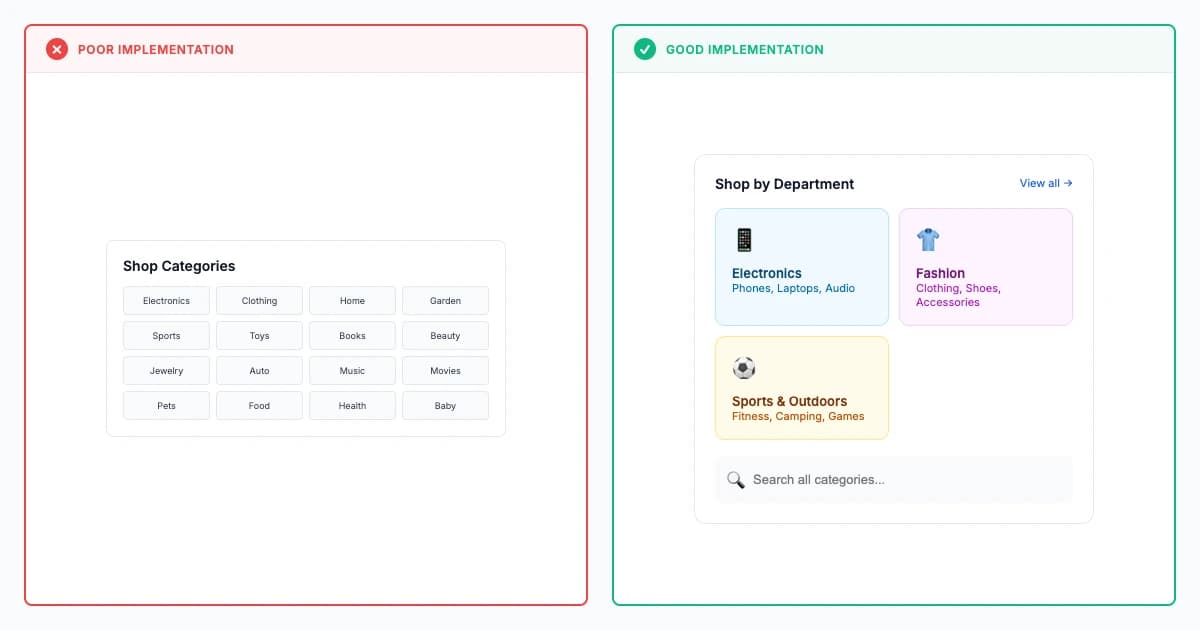
Streamlined navigation vs overwhelming dashboard comparison
✗ Poor Implementation:
Complex dashboards with 20+ simultaneous options and unclear priorities causing decision paralysis and user abandonment. effectively
✓ Good Implementation:
Search engines Search's clean interface with minimal initial choices, then progressive result refinement that guides users efficiently through decision-making.
Modern Examples (2023-2026)
 Example 1: Linear - Command Palette Contextual Filtering
Focus: Why show all 100 commands when context reveals the 7 you need? Selecting an issue displays issue actions, selecting assignee shows people options.
Insight: Context-aware filtering maintains 5-9 visible choices while accessing comprehensive features—users decide faster because they're not paralyzed evaluating irrelevant options.
Linear's command palette (Cmd+K) demonstrates sophisticated Hick's Law optimization through contextual filtering and intelligent prioritization. Rather than presenting all 100+ available commands simultaneously creating overwhelming choice evaluation, the palette shows 7-10 contextually relevant commands based on current view, selected items, and recent usage. Creating new issue shows issue-related commands; selecting assignee shows people-related commands. This context-aware filtering maintains choice quantity within optimal Hick's Law ranges (5-9 options) while providing comprehensive feature access through search. Users experience fast decision-making with minimal cognitive load while maintaining power-user efficiency.
 Example 2: Figma - Hierarchical Tool Organization
Focus: 8 main tools appear first (Frame, Shape, Pen, Text), then selecting "Shape" unveils 6 variants (rectangle, ellipse, polygon).
Insight: Breaking 30 tools into two 6-8 option decisions feels simpler than one 30-option screen, even though logarithmic math says total time stays similar—perceived complexity matters.
Figma's tool system applies Hick's Law through two-tier organization—8 primary tool categories with nested variants revealed on selection. Users first select among 8 main tools (Frame, Shape, Pen, Text, etc.)—a quantity within optimal Hick's Law range. Selecting "Shape" reveals 6 shape variants (rectangle, ellipse, polygon, etc.) as secondary choice. This hierarchical structure breaks 30+ total tool variations into two sequential 6-8 option decisions rather than single overwhelming 30-option choice. Total decision time remains similar (logarithmic scaling means 30 options ≈ 2× time of 8 options) but perceived complexity reduces dramatically improving usability while maintaining full creative toolset.
 Example 3: Notion - Progressive Block Menu Disclosure
Focus: Typing "/" displays 8-10 common blocks instantly. Continue typing "/tab" and watch 50 options collapse to 3 table variants through progressive filtering.
Insight: Users never evaluate all 50 block types simultaneously—search-driven filtering keeps choices manageable at every keystroke, respecting decision-time limits while delivering completeness.
Notion's block insertion menu demonstrates progressive disclosure optimizing Hick's Law through staged choice revelation. Typing "/" shows 8-10 frequently used block types (heading, bullet list, to-do, toggle, etc.) enabling immediate common selections. Typing continues filtering results progressively—"/tab" instantly narrows to table-related blocks, "/cal" to calendar blocks. This progressive filtering maintains manageable choice quantities throughout interaction—users never face 50+ simultaneous block type evaluation despite comprehensive block library. The search-driven progressive disclosure respects Hick's Law while providing feature completeness.
Role-Specific Guidance
For Designers
Menu design optimization fundamentally depends on Hick's Law principles. Desktop applications historically presented feature-rich menus with 10-15+ items per menu creating substantial decision delays. Modern interfaces like Linear's command palette apply Hick's Law optimization—showing contextually filtered commands (typically 5-8 visible) with search-based progressive revelation. This reduces initial choice evaluation while maintaining full feature access through search, dramatically improving efficiency for both novice users (fewer overwhelming choices) and experts (keyboard-driven search).
Scientific Validation Checklist
- Limit simultaneous choice presentations to 5-9 options for complex decisions or 3-5 for time-critical interactions balancing cognitive capacity constraints against information access needs
- Design hierarchical navigation structures breaking large option sets into sequential manageable choices maintaining efficiency through logarithmic scaling optimization
- Implement smart defaults reducing active decisions by pre-selecting common choices while maintaining customization capability through easy override mechanisms
- Create search functionality as Hick's Law escape valve enabling direct access bypassing choice evaluation when users know specific targets
- Test decision completion times across choice quantity variations validating whether optimization improves efficiency through reaction time measurement
For Developers
E-commerce filtering demonstrates Hick's Law application at scale. Product category pages potentially displaying hundreds of items create impossible choice evaluation. Amazon's filtering systems enable progressive narrowing—users select category (8-12 choices), then sub-category (5-10 choices), then apply filters (price, rating, features) sequentially reducing from thousands to dozens of products. Each filtering step presents manageable choice quantity while hierarchical progression efficiently narrows vast inventory to evaluable sets.
Scientific Validation Checklist
- Build contextual filtering systems dynamically adjusting choice presentations based on user context, recent actions, and task requirements maintaining optimal choice quantities
- Implement keyboard shortcuts enabling power users to bypass choice evaluation entirely through learned procedural responses becoming automatized with practice
- Create intelligent search with progressive filtering enabling efficient navigation through large option spaces without overwhelming simultaneous choice presentation
- Optimize menu rendering performance ensuring choice presentation responds instantly—delays compound Hick's Law decision time creating combined cognitive and temporal frustration
- Develop analytics tracking decision times and abandonment patterns correlating with choice quantities identifying Hick's Law optimization opportunities
For Product Managers
However, overzealous choice reduction creates opposite problem—forcing users through excessive sequential decisions accumulating total time beyond single-step alternatives. Hamburger menus hiding all navigation behind single icon appear to reduce choice but often increase task time by requiring multiple sequential menu navigations each presenting new choice sets. The cumulative effect of 3-4 sequential 5-option menus exceeds decision time of single 15-option menu despite each individual step feeling simpler—total information processing remains constant but interaction cost increases.
Scientific Validation Checklist
- Prioritize choice architecture optimization recognizing that logarithmic scaling means strategic choice reduction creates disproportionate efficiency gains
- Measure decision time impacts from choice quantity experiments validating Hick's Law optimization improves task completion and user satisfaction
- Balance feature completeness desires against cognitive efficiency recognizing that exposing all features simultaneously degrades rather than improves usability
- Communicate Hick's Law effects through reaction time data demonstrating mathematical relationships between choice quantity and user performance
- Establish choice quantity guidelines for different interaction types (navigation: 7-9 items, critical decisions: 3-5 options, filters: 5-7 facets) providing teams concrete constraints
Common Pitfalls
-
Overwhelming Unfiltered Navigation: Many enterprise applications present 20-30 simultaneous navigation items creating decision paralysis violating Hick's Law principles. Users face overwhelming choice evaluation scanning lengthy menus attempting to locate relevant sections—decision time increases substantially while satisfaction drops. These interfaces prioritize "everything visible" accessibility over cognitive efficiency creating poor usability despite comprehensive feature exposure. Effective alternatives employ hierarchical organization, search functionality, and progressive disclosure maintaining navigation efficiency while providing complete feature access.
-
Linear Scaling Assumptions: Expecting choice reduction from 20 to 10 options halves decision time when logarithmic scaling creates smaller ~30% improvements—misunderstanding mathematical relationship
-
Excessive Choice Fragmentation: Breaking choices into too many sequential small steps accumulating total decision time exceeding single-step alternatives through interaction overhead
-
Ignoring Learned Response Exceptions: Applying Hick's Law optimization to practiced behaviors where shortcuts and procedural memory already bypass choice evaluation
-
Choice Reduction Without Context: Arbitrarily limiting options without understanding user needs potentially hiding necessary functionality pursuing mathematical optimization over user value
-
Simultaneous Multi-Dimensional Choices: Presenting choices varying across multiple attributes simultaneously (color + size + material) creating multiplicative choice complexity exceeding simple option counting
Key Takeaways
- Hick's research: demonstrated decision time follows T = a + b log₂(n) formula with doubling choices adding constant ~150-200ms increments rather than doubling total time
- Logarithmic Scaling Enables: moderate choice increases without devastating performance impacts but also means strategic reduction creates disproportionate efficiency gains
- Hyman's extension: revealed unequal choice probabilities reduce decision time—common selections respond faster because brain optimizes for frequent cases
- Well-practiced Responses Bypass: Hick's Law through procedural memory—keyboard shortcuts and learned interactions achieve constant time regardless of choice set size
- Cumulative Sequential Decisions: compound—multiple small choice sets can exceed single large choice set total time despite each step feeling individually simpler
AI Validation Prompts
Scientific prompts optimized for Cursor, V0, Claude, and Lovable
Cursor Optimized
V0 Optimized
Claude Optimized
Lovable Optimized
ReferencesMultiple academic and industry sources
ReferencesMultiple academic and industry sources
Primary Sources
- Hick, W. E. (1952). "On the rate of gain of information." Quarterly Journal of Experimental Psychology, 4(1), 11-26.
- Hyman, R. (1953). "Stimulus information as a determinant of reaction time." Journal of Experimental Psychology, 45(3), 188-196.
- Card, S. K., Moran, T. P., & Newell, A. (1983). The Psychology of Human-Computer Interaction. Lawrence Erlbaum Associates.
- Donders, F. C. (1868). "On the speed of mental processes." Acta Psychologica, 30, 412-431.
Industry Research
- Nielsen Norman Group. (2024). "Hick's Law: Making the Choice Easier for Users." https://www.nngroup.com/articles/hicks-law/
- Hick, 1952. https://www2.psychology.uiowa.edu/faculty/mordkoff/InfoProc/pdfs/Hick%201952.pdf
- Proctor & Schneider, 2018. https://web.ics.purdue.edu/~dws/pubs/ProctorSchneider_2018_QJEP.pdf
- Card, Moran, & Newell, 1983. https://books.google.com/books/about/The_Psychology_of_Human_Computer_Interac.html?id=H4ZzQgAACAAJ
- Hyman, 1953. https://psycnet.apa.org/record/1954-02774-001
- Wikipedia. https://en.wikipedia.org/wiki/Hick%27s_law
- Springer, 2011. https://link.springer.com/article/10.3758/s13414-010-0062-x
- The Decision Lab. https://thedecisionlab.com/reference-guide/design/hicks-law
- ParallelHQ, 2025. https://www.parallelhq.com/blog/what-hick-s-law
- IntechOpen, 2024. https://www.intechopen.com/chapters/1201769
- ACM Digital Library. https://dl.acm.org/doi/10.1145/1240624.1240723
- PDF. http://www2.psychology.uiowa.edu/faculty/mordkoff/InfoProc/pdfs/Wifall%20et%20al%20in%20press.pdf
Enjoyed This Free Principle?
This is 1 of 12 free principles. Get the Principles Library for all 195+ research-backed principles with complete research foundations, modern examples, and role-specific implementation guidance.